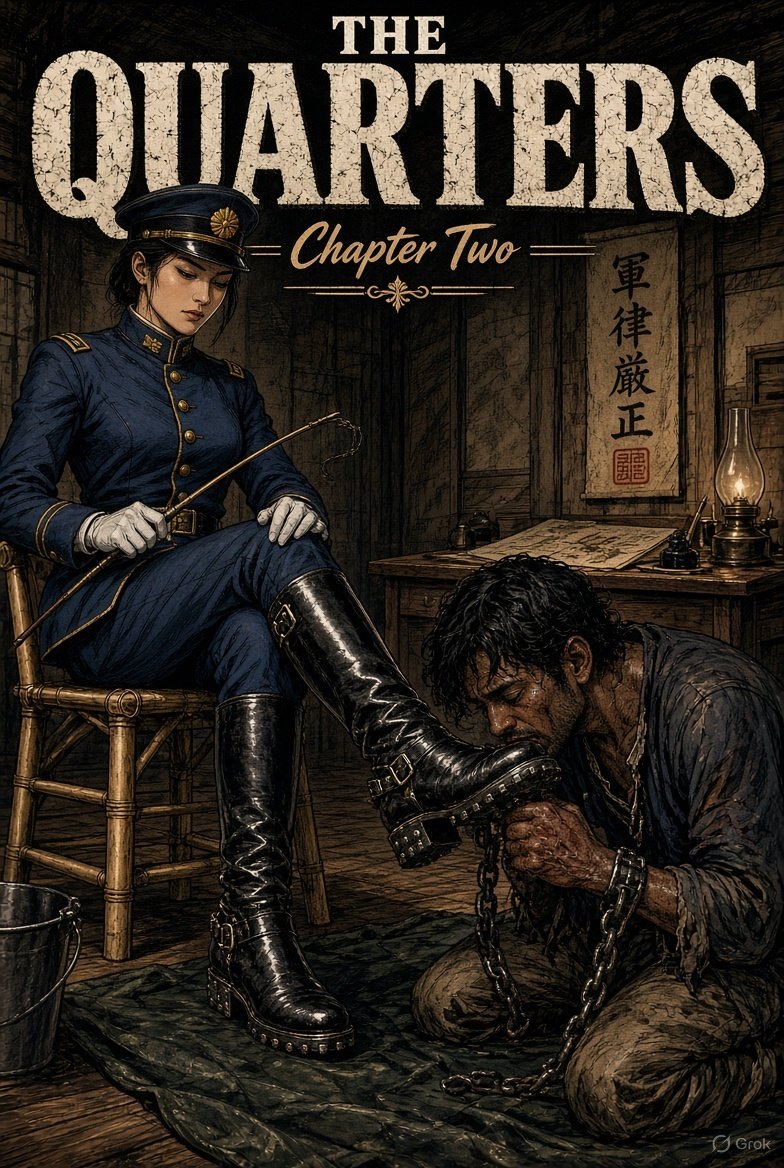
Chapter 2 – The Quarters
THE IRON HEEL
They came for him before dawn.
Sergeant Oda kicked Arjun awake, hauled him up by the collar, and
marched him across the compound while the rest of the prisoners pretended
to sleep. His broken fingers had swollen overnight into something purple
and useless. His stomach was a hollow knot. The ration he had refused was
still there in the mud where she had ground it, now crawling with ants.
The Captain's quarters stood at the far end of the fort: a former
magistrate's house the army had requisitioned, with a tiled roof and paper
screens that had been replaced with wooden shutters after rebels put a torch
to one wing. Two sentries flanked the door. Neither looked at Arjun as he
was pushed inside.
The room was spare and fiercely orderly. A writing desk with maps of
the northern hills pinned beneath stones. A rack holding her sabre and a
riding crop. A bamboo cot. And in the centre of the floor, on a square of
oilcloth, stood a small wooden stool and a basin of water.
Captain Mizuhara sat at the desk, writing. She did not look up.
"Kneel," said Oda, and forced him down onto the oilcloth.
For a long time the only sound was her brush moving across paper.
Arjun knelt with his ruined hand cradled against his chest, sweat running
into his eyes. He understood what she was doing. She wanted him to wait,
to feel the silence, to wonder. He tried not to give her the satisfaction, but
his heart was hammering anyway.
At last she set down the brush.
"Your name," she said.
"Arjun Rathore."
"Where were you born?"
"Surat. In the Bombay Presidency."
"And what was the Bombay Star carrying when it struck our reef?"
"Cotton goods. Kerosene. Tinned food for the merchants in Tamsui."

She did not seem angry. She nodded to Oda, who took the riding crop
from the rack and handed it to her. She laid it across her knee.
"Let me explain your position, because I think you do not understand it.
You are not a soldier. You are not protected by any flag. The British consul
in Tamsui does not know you survived, and if he did, he would not trouble
himself over a lascar. As far as the world knows, you drowned on that reef."
She leaned forward. "Which means that whatever happens in this room,
happens to a dead man. There is no one to complain to. There is no court.
There is only me."
She let that settle in the air.
"Now. Clean."
Arjun stared at the boot. He thought of the old farmer licking rice from
her heel, and how he had despised the man for it. He thought of his mother
in Surat, who believed he was somewhere on the China Sea earning money
for his sister's wedding.
The crop struck him across the face. Once, sharp, precise, opening a line
of fire across his cheekbone.
"Clean."
He leaned forward. His lips touched the leather. It tasted of grit, of
polish, of something rank and animal beneath. He dragged his tongue
across the iron studs and felt the mud break loose against his teeth.
"Slower," she said. "Between the nails. All of it."
He did as she said. It seemed to last hours. When he finished one boot
she simply uncrossed her legs and presented the other, and he began again,
his eyes streaming, his broken hand throbbing against his chest. Once he
gagged, and she pressed the sole flat against his mouth and nose until he
stopped, holding it there until his lungs burned and his vision spotted,
before letting him breathe.
When it was done, she examined the soles like a quartermaster
inspecting equipment.
"Acceptable," she said. "Tomorrow they will be dirtier. I shall make
certain of it."
She stood and pushed him backward with her foot, a casual shove to the
chest that sent him sprawling onto the oilcloth. Then she stepped onto his
stomach and stood there, looking down at him, her full weight pressing his

breath out in short, desperate bursts.
"The rifles," she said. "You have until tomorrow to remember. And if
you do not remember, I will stop asking you, and I will start asking the old
man who licked my boots last night. He will say anything I want to hear.
Then I will hang both of you from the gate for smuggling, and the report I
send to Taihoku will be very tidy."
She stepped off him.
"Take him back. Give him water. Not food."
As Oda dragged him to the door, she spoke once more, almost gently.
"You looked at me yesterday as though you were a man, Rathore-san.
Today you know what you are. Tomorrow, I think, you will start to believe
it."

Back in the yard, the prisoners avoided his eyes. Only one approached: Lin,
the young rebel, his face still bruised in the shape of her sole. He crouched
beside Arjun and pressed a handful of rice into his good hand, rice he had
hidden in his shirt.
"You didn't know about the guns," Lin said in halting English. It wasn't
a question.
Arjun shook his head.
Lin was quiet for a moment. Then he leaned closer.
"I know who they were for," he whispered. "And if she learns it from
you, many people will die. So listen to me carefully, Indian. We must
decide tonight what you will tell her."