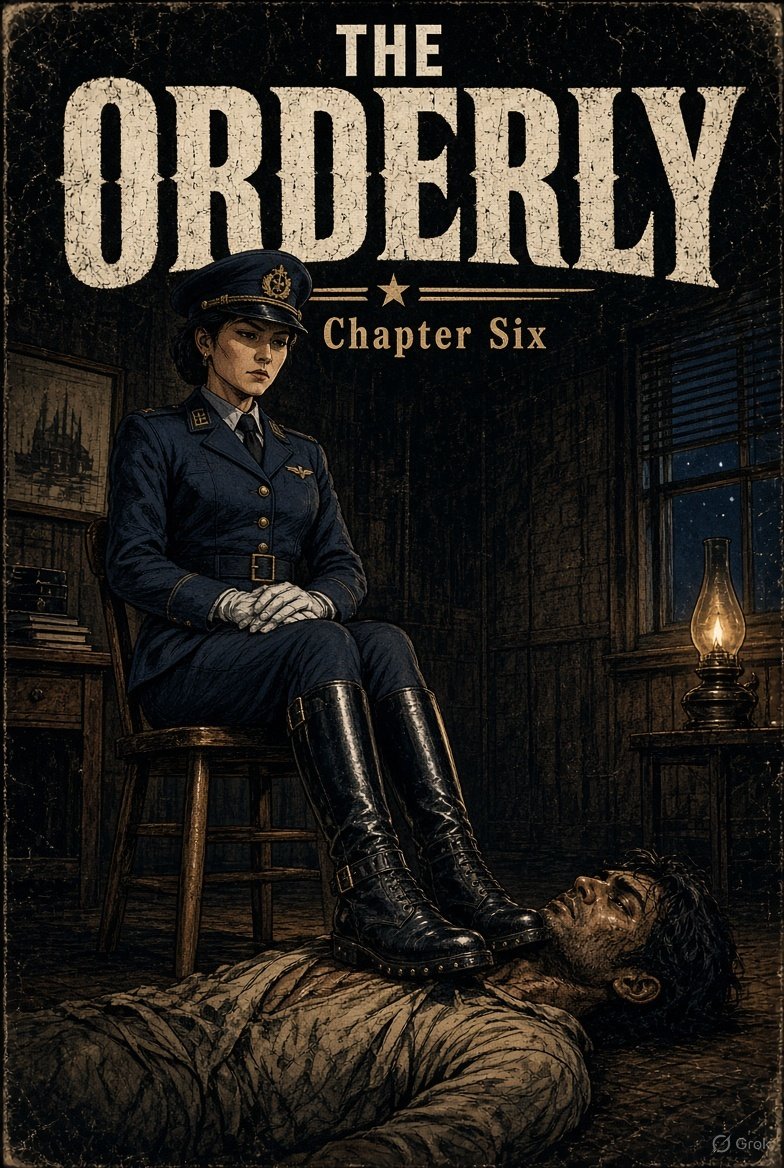
The days took on a shape, and the shape was her.
Arjun knelt at her threshold before dawn, forehead near the stones, until
he heard her rise. When Sergeant Oda opened the door, he crawled in on his
knees and elbows, his splinted hand held off the floor. Her boots stood
beside the cot where she had left them the night before, still carrying
whatever she had walked through the previous day. He cleaned them the
way she had taught him: soles first, every row of hobnails, then the heels,
then the uppers until the leather shone and he could see his own face in the
toes. It took most of an hour. She sat at her desk reading dispatches and did not look at him once, except to glance down when he finished, inspect thework, and either nod or push the boot back against his mouth without a
word.
Then she dressed, and he held each boot while she stepped into it, and
when she stood, he lowered himself flat so she could step over him to the
door. That was the rule. She never walked around him. Always over, or on.
In the yard, he crawled behind her at a distance of exactly two paces.
The soldiers had laughed the first day. By the third, they had stopped
noticing, which was worse.
The morning inspection was when she was most herself.
She walked the rows of prisoners, which had grown to over forty since
the attack, with Arjun behind her and Oda at her side. She rarely raised her
voice. She did not need to. A prisoner who had not bowed low enough felt
her boot on the back of his head, pressing his face into the dirt until his
forehead touched it, held there while she discussed supply shortages with
Oda over him as if he were a stone underfoot.
On the fourth morning, one of the rebels from the gateway, a stocky
man with a burn across his neck, did not lower his eyes quickly enough.
She stopped.

"Rathore-san," she said, without looking back. "Come."
Arjun crawled forward.
"This man looked at me. Show him what we do with eyes that look
where they should not."
He did not understand at first. Then she lifted her boot and set it gently
on Arjun's back, between his shoulder blades, pressing him down until his
face was level with the prisoner's knees.
"You look at him," she told the rebel in Hokkien, and then in English
for Arjun's benefit. "This was a proud man. A sailor. He looked at me on
the first day as you did. Now look at him."
She stepped fully onto Arjun's back. He braced his good hand against
the dirt and held. Her weight settled onto his spine as if he were a step in a
staircase. From there she looked down at the rebel.
"This is where you are going," she said. "I only wished to show you the
road."
The rebel lowered his eyes. She stepped off Arjun and moved on.
Behind her, the man was shaking.
Huang Wen-de lasted six days.
The three men he had named were brought in from Tamsui and
questioned in the storehouse. The schoolteacher knew nothing. The
boatman knew nothing. The rival merchant, after a night with Oda, knew a
great deal, most of it about Huang's arrangements with Chen's
quartermaster.
The Captain had Huang brought into the yard on the seventh morning.
He had lost his rings and his silk jacket. He wore a prisoner's rough cotton
and wept continuously.
"You gave me three names," she said pleasantly. "One of them has
given me yours. Twice over."
"Captain, I beg you, I have children..."
"So do many of the men you sold." She looked at him with mild
curiosity. "Do you remember, Huang-san, how you stood on my orderly?
How you enjoyed it?"
He shook his head frantically.

"You did. I watched your face." She turned. "Rathore-san. Stand up."
It was the first time in a week she had allowed him to stand. His knees
nearly buckled.
"Huang-san stood on you. Now you will stand on him."
Two soldiers forced Huang onto his back in the dirt. The Captain
waited.
Arjun looked down at the round, tear-streaked face. He remembered the
slipper on his mouth, the weight crushing his ribs, the nervous delighted
laughter. He found, to his horror, that some part of him wanted to do it.
He didn't move.
"Ah," said the Captain. "You hesitate." She walked over to where the
old Hakka farmer knelt among the prisoners and, without a word, kicked
him in the stomach. The old man folded over in the dirt, gasping.
Arjun stepped onto Huang's chest.
"His face," she said.
He moved his bare foot to Huang's face. It was nothing like her boots.
There was no iron, no leather. Only skin on skin, a sickening intimacy.
Huang whimpered beneath it.
"Harder," she said. "You weigh nothing. Put yourself into it."
He pressed down. He felt Huang's nose flatten under his heel, felt the
man's breath hot against his sole, and he pressed because the old man was
lying in the dirt and because she was watching and because somewhere in
the last week the line between what he would do and what he would not had
worn so thin he could no longer find it.
"Enough."
He stepped off. His whole body was shaking.
She looked at him for a long moment, and there was something in her
face he had not seen before. Not pleasure. Something colder, more
considering.
"Good," she said. "Now you understand what I am. You have been me
for one minute. Remember how it felt."
Huang was hanged at noon from the eastern gate beside the charred
timbers. Arjun was made to kneel beneath the body and watch until the
Captain allowed him to crawl away.
That night she sent for him late.
She was sitting on the stool in the centre of the room, her tunic
unbuttoned at the collar, a single lamp burning. Her boots were on. She
pointed to the floor at her feet and he lay down on his back without being
told. She rested both boots on his chest.
For a long time she said nothing. He stared at the ceiling beams and
listened to the rain on the roof.
"Chen has sent a message," she said at last. "Through a woodcutter. He
offers to exchange prisoners. Twelve of his men for two of my soldiers
taken at the stream ambush."
Arjun said nothing. He had learned not to speak unless asked.
"I am going to accept," she said. "And I am going to include you among
the twelve."
His heart lurched.
She leaned forward, her elbows on her knees, and her weight pressed
down through the soles onto his sternum.
"Lin has told them you turned back to free the old man. They think you
are brave. Some of them think you are a fool. A few, perhaps, suspect I
have turned you. They will watch you. That is fine. Let them watch." She
pressed a heel into the soft place beneath his ribs. "You will tell them
nothing false. You will tell them only the truth: that I beat you, starved you,
made you lick my boots. You have the bruises to prove it. They will believe
you, because it is true."
"And then?" he whispered. It was the first question he had asked her in
days.
She allowed it.
"And then you will live among them. Eat with them. Learn where Chen
sleeps, where the rifles are kept, which villages feed his men. And every
seventh day, a woodcutter will come to their camp selling kindling. You
will buy a bundle from him and tell him what you have learned."
"And if I don't?"
She smiled. She lifted one boot from his chest and set it down, very
gently, across his mouth.
"Then the old man dies. Not quickly. I will describe it to the woodcutter
in detail so he can describe it to you." The sole pressed down. "And
afterward, I will send word to Chen that you have been my informant all
along. With proof. Letters in your name. Payments. Do you think they will
believe you then?"
He could not answer with her boot on his mouth. She did not require an
answer.
"You see the shape of it," she said. "You cannot betray me without
betraying him. You cannot save him without betraying them. And you
cannot run, because they will be watching you and I will be watching
them." She lifted her boot. "It is a very small cage, Rathore-san. I built it
just for you."
She stood. She stepped onto his chest, then over him, walked to her
desk, and began writing as if he were no longer there.
"The exchange is in three days," she said without turning. "Until then,
you will be treated worse than ever. Every bruise must be real. Every scar
must be fresh. They must believe you hate me."
Arjun lay on the floor in the lamplight, staring at the ceiling.
"I do hate you," he said.
The brush paused.
"Yes," she said, and he could hear the smile in her voice. "That is what
makes it perfect."
He moved in on a Saturday, with two suitcases and a backpack.The doorman watched him drag everything across the marble lobby anddid not offer to help. When Vikram reached the elevator, the doorman clearedhis throat.“Residents’ elevator,” he said in Korean, pointing. “Service elevator is atthe back.”“I’m a resident now. Apartment 1004.”The doorman picked up the…
A Novel of Captivity, Cruelty, and Devotion CHAPTER ONE The Captain’s Boots Formosa, Autumn 1895 The monsoon had not yet broken, and the heat inside the stockade atKeelung sat on a man’s chest like a wet sack of rice.Arjun Rathore had been in chains for three days. The Bombay Star, theBritish merchant steamer on which…
The Iron Leg The first rebels came over the palisade with ladders made of green bamboo,lashed together so hastily that one of them snapped under the weight ofthree men and dropped them screaming onto the sharpened stakes below.Arjun saw it all from the yard. The prisoners had been chained in rowsto iron rings sunk into…