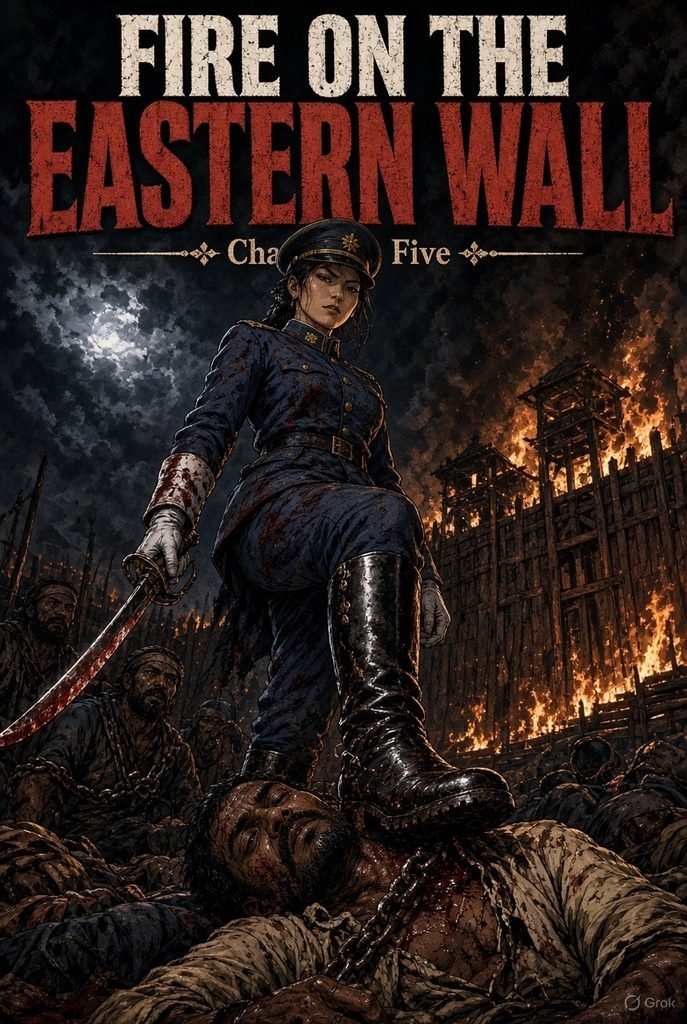
Chapter 5 – Fire on the Eastern Wall
The Iron Leg
The first rebels came over the palisade with ladders made of green bamboo,
lashed together so hastily that one of them snapped under the weight of
three men and dropped them screaming onto the sharpened stakes below.
Arjun saw it all from the yard. The prisoners had been chained in rows
to iron rings sunk into the ground, and there was nowhere to go and nothing
to do but watch. Smoke rolled across the compound. Muzzle flashes
stuttered along the walls like lightning in a cloud. The Japanese garrison,
perhaps eighty men, poured out of the barracks half-dressed, fixing
bayonets as they ran.
And through the middle of it walked Captain Mizuhara.
She did not run. She did not duck. She walked along the inside of the
eastern wall with her sabre drawn and her pistol in her left hand, calling out
orders in a voice that carried over the gunfire, flat and unhurried, as if she
were directing a drill. Where she went, the soldiers steadied. A section that
had broken and fallen back from the burning gate saw her coming and
turned around again.
"She knew," Lin whispered beside him. His voice was thick with blood
from his broken teeth. "Look at her. She knew they would come."
Arjun looked. And Lin was right. There were sandbags already stacked
behind the eastern gate, a field gun he had never seen before wheeled into
position facing it, and a line of riflemen kneeling behind the bags in perfect
order. They had not been placed there in the last ten minutes.
"The rifles," Arjun said slowly. "She brought them up from the wreck.
She let the whole island know where they were. She wanted Chen to come."
The eastern gate burst open. A wave of men surged through it, shouting,
some with the Sniders they must have bought earlier from other smugglers,
most with spears and swords and old matchlocks.
The field gun fired.
Arjun had been at sea during storms that snapped masts. He had never
heard anything like the sound that gun made, or the silence that followed it.
When the smoke cleared, the gateway was a tangle of bodies and the
survivors were falling back into the dark.
"Fire," the Captain said, and the riflemen fired.

It should have been over. But in the confusion, a group of rebels had come
over the northern wall where no one was watching, near the stables and the
pit, and suddenly they were in the prisoners' yard.
A young man with a machete ran straight to the iron rings. He hacked at
Lin's chain until the link sprang open, then moved down the row. The
Formosan prisoners were being cut free one by one, some of them already
running toward the northern wall.
The machete came down on Arjun's chain. It took three blows. On the
third, the link parted.
He was free.
For a moment he could not understand it. He knelt there with the broken
chain in his hands while men ran past him in the smoke. Then Lin grabbed
his shoulder and hauled him up.
"Come. Now. The north wall."
They ran. Arjun's legs were weak from hunger and the pit, and his
broken hand screamed with every stride, but he ran. Past the stables. Past
the flooded pit, still covered by its grate. The northern wall rose ahead, a
ladder propped against it, a rebel at the top waving them up.
Then he heard the old man cry out.
He turned. The Hakka farmer, the one who had licked the Captain's
boot on the first night, had fallen near the stables. His chain was still
attached to his ankle; someone had cut it from the ring but not from his leg,
and it had tangled around a post. He was pulling at it with both hands,
sobbing.
"Leave him," Lin said.
Arjun ran back.
He would never be able to say why. He had despised the old man. He
owed him nothing. But he ran back through the smoke, knelt beside him,
and began working the chain loose from the post with his good hand.
"Go," the old man wept. "Go, go..."
The chain came free. Arjun got an arm under him and pulled him up.
And a boot came out of the smoke and hit him in the chest so hard that
he flew backward and landed in the mud with the breath gone from his
body.
Captain Mizuhara stood over him. Her face was streaked with soot.
There was blood on her sabre and a spray of it across her boots.
"You came back," she said. She sounded almost surprised. "For him?"
Arjun could not answer. He could not breathe.
She glanced toward the northern wall. Lin was at the top of the ladder,
looking back. For a moment their eyes met across the yard. Then Lin was
gone, over the wall and into the night.
The Captain did not chase him. She did not even raise her pistol. She
looked back down at Arjun, and she put her boot on his throat.
"Stupid," she said softly. "So very stupid. And so very interesting."

By dawn, the fighting was over.
The garrison had lost nine men. The rebels had lost perhaps sixty, most
of them in the gateway. Twenty-three had been taken alive. They knelt now
in the yard in long rows, hands bound behind their backs, surrounded by
soldiers who had spent the night being shot at and were in no mood for
mercy.
Arjun knelt at the end of the front row, chained once more, beside the
old farmer. The old man had not stopped crying since the Captain found
them.
She came out at sunrise. She had washed the soot from her face and
changed her tunic, but she had not cleaned her boots. They were still
spattered with blood and mud and ash from the gateway. Arjun understood
immediately that this was deliberate.
She walked along the front row, slowly, looking down at each prisoner.
She stopped before a man of about thirty with a wide, defiant face and a
bandaged arm. He met her eyes.
"You are Chen's lieutenant," she said. "Wu. I have heard of you."
He spat at her boots.
The soldiers around the yard went very still. The Captain looked down
at the spittle on her boot. Then she lifted that foot and placed the sole flat
against Wu's face and pushed, slowly, steadily, until he toppled backward
from his knees and lay on his bound arms, arched and helpless.
She stepped up onto his chest.
"You will clean that," she said, looking down at him. "With your
mouth."
He cursed her in Hokkien.
She brought her heel down on his face.
Arjun looked away. He heard it anyway: the heel, again and again, the
grunt of breath with each stamp, the terrible wet sounds. When he looked
back, Wu was no longer cursing. His face was a ruin. She was still standing
on his chest.
"Now," she said, and placed the bloodied sole of her boot against his
mouth. "Clean."
He did.
She made him clean both boots completely while the other prisoners
watched. Then she stepped off him and walked down the line, and at each
man she stopped and held out her boot, and each man, having seen what
happened to Wu, bent and licked the leather. Some wept as they did it.
Some shook so badly they could barely manage it. One boy who could not
have been more than sixteen vomited, and she waited patiently until he was
finished and then made him begin again.
She reached Arjun last.
She did not hold out her boot. Instead she stood in front of him and
looked down for a long time.
"Sergeant Oda," she said. "What was the prisoner doing when I found
him last night?"
"Freeing another prisoner, Captain."
"Was he escaping?"
"He was at the wall, Captain. And then he turned back."
"For whom?"
Oda pointed at the old farmer.
The Captain nodded thoughtfully. She stepped past Arjun and stood
before the old man instead.

"You are the reason he did not escape," she said to the farmer in slow,
careful Hakka, then repeated it in English so Arjun would understand. "He
gave up his freedom for you. What do you think of that?"
The old man shook and said nothing.
She stepped on the old man's hands where they were bound behind him,
pinning him forward so his face was near the ground. Then she looked back
over her shoulder at Arjun.
"Here is what you have taught me, Rathore-san. Pain does not move
you. I stood on your broken hand and you did not tell me what I wanted. I
put you in the pit and you did not break. But this," she pressed down, and
the old man cried out, "this moves you. Other people's pain."
"Stop," Arjun said.
"Ah." She pressed harder. "There. You see? You speak without being
asked, for him. Never for yourself."
"Please. He's old. He's done nothing."
"Then you will do something for him." She took her foot off the old
man and turned fully to face Arjun. She lifted her boot, the blood from the
gateway dried dark on the sole, and held it before his face. "From today,
you will be my orderly. You will clean my boots. Every day. With your
mouth. You will kneel at my door at dawn and wait for me. When I sit, you
will be my footstool. When I walk through this yard, you will crawl behind
me. You will do everything I say, instantly, without hesitation. And each
time you refuse me, or hesitate, or look at me the way you looked at me on
the first day, I will not punish you."
She let the words hang.
"I will punish him."
She nodded at the old farmer.
Arjun looked at the boot in front of his face. At the dried blood. At the
old man trembling in the mud beside him, the man he had once despised for
doing exactly what he was about to do.
He bent forward and put his lips to the sole.
"Good," she said, very softly, so that only he could hear. "Now I have it.
The thing you kept back. It is mine."

That afternoon, as Arjun knelt outside her quarters with his face near the
threshold as instructed, he heard her speaking inside with Sergeant Oda.
"The one who escaped. Lin."
"We lost him in the hills, Captain."
"No. I let him go. He will run straight back to Chen and tell him
everything he saw." A pause. The scratch of her brush on paper. "And he
will tell Chen that the Indian stayed behind. That the Indian turned back.
Chen will wonder why. He will wonder whether the Indian is mine."
"Is he, Captain?"
Her laugh drifted out through the shutters, soft and pleased.
"He is now. And very soon, Sergeant, I am going to send him back to
them."
Kneeling on the stones, Arjun felt the blood leave his face.