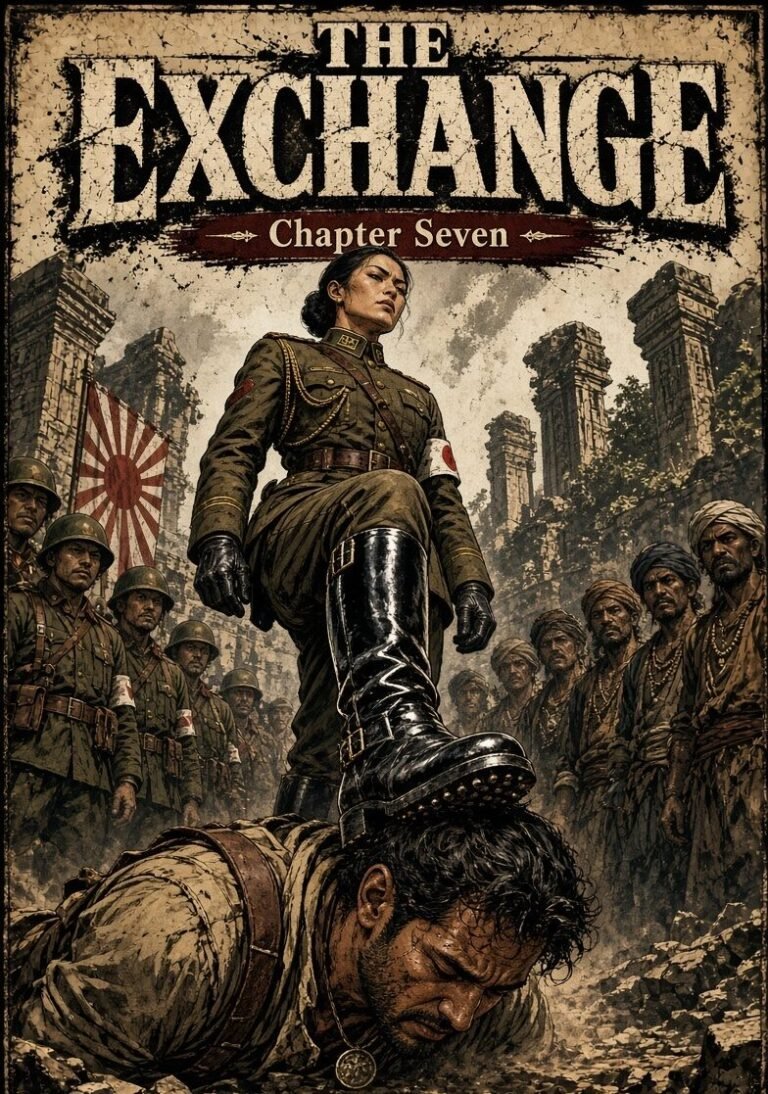
The Iron Heel
A Novel of Captivity, Cruelty, and Devotion
CHAPTER ONE
The Captain’s Boots
Formosa, Autumn 1895
The monsoon had not yet broken, and the heat inside the stockade at
Keelung sat on a man's chest like a wet sack of rice.
Arjun Rathore had been in chains for three days. The Bombay Star, the
British merchant steamer on which he'd served as a lascar, had run aground
on the reefs north of the harbour during a storm. Most of the crew drowned.
Arjun had crawled onto the rocks with salt in his lungs and blood in his
mouth, straight into the bayonets of a Japanese patrol. The island had been
Japan's for barely five months, and the occupying army saw spies in every
shadow. A brown-skinned stranger in a British ship's jacket was, to them,
proof enough.
They marched him inland with his wrists bound behind him, through
villages that were still smoking from the pacification campaign, until they
reached a timber fort ringed with bamboo stakes. Inside, forty or fifty
prisoners sat in the dirt of an open yard: Formosan rebels, Hakka farmers, a
pair of Chinese deserters, and now him.
"Who commands here?" Arjun asked the guard who shoved him down.
The guard, a young private with a pockmarked face, smiled without
humour. "You will meet her," he said in broken English. "Everyone meets
her."

She came at noon.
The prisoners knew before Arjun did. The yard fell silent. Men who had
been murmuring stopped mid-word. An old Hakka farmer beside him
lowered his forehead to the dirt and stayed there, trembling.
The gate opened, and Captain Mizuhara Reiko walked in.
She was not tall, but she carried herself as if the yard belonged to her,
which it did. She wore the dark blue tunic of an Imperial Army officer
brass buttons polished to mirrors, a sabre at her hip, and white gloves she
never seemed to dirty. Her hair was pinned severely under her cap. But it
was her boots that every prisoner watched: black leather riding boots,
knee-high, the soles thick and studded with iron hobnails, the heels capped
in steel. They rang on the packed earth like a slow clock.
Rumour said she was the daughter of a samurai house ruined in the
Restoration, that she had earned her commission through connections in
Tokyo and something darker, that she had been sent to Formosa because
even the army found her difficult to keep at home. Whatever the truth, the
men of the garrison saluted her faster than they saluted anyone.
"Sergeant Oda," she said, not looking at him. "The new one."
"There, Captain. The Indian from the wreck."
She crossed the yard. Arjun kept his eyes up, and that was his first
mistake.
"You look at me," she said in precise, school-taught English.
"Interesting. Do Englishmen teach their dogs to look at people?"
"I am not an Englishman's dog. I am a sailor. My ship—"
The kick came so fast he never saw it. Her boot caught him under the
jaw and snapped his head back, and he was on the ground with the sky
spinning above him before the pain even arrived.
"You will speak," Captain Mizuhara said calmly, "when I ask you a
question. That was not a question."
She didn't interrogate him that day. That was the worst part. She made him
watch.
A Formosan rebel, a lean young man named Lin who had been caught
with a rusted musket, was dragged forward and forced onto his back. Two
soldiers pinned his arms.
"This one has been lying to me for a week," the Captain said, to no one
in particular. "He says he knows nothing about the men in the hills."
She placed the sole of her boot on Lin's face. Not a stamp, not yet. She
simply set it there, the hobnails pressing into his cheek and forehead, and
slowly shifted her weight onto it. Lin's muffled scream came from under the
leather.
"Where," she said, pressing, "are they camped?"
He shouted something in Hokkien. The interpreter, a nervous clerk,
stammered, "He says he does not know, Captain."
She lifted her boot and brought the heel down beside his ear, close
enough that the steel cap scraped the skin. Then she stepped up fully onto
his chest, both boots, standing on him as if he were a mounting block. The
soldiers holding his arms didn't look at her face. Lin's breath came out in a
thin, crushed whistle.
"Tell him," she said to the interpreter, "that I can stand here all
afternoon. I am not tired."
It took eleven minutes. Arjun counted. Then Lin gave up a valley name,
and she stepped down, wiped the sole of her boot across his shirt as if
cleaning mud off on a doormat, and walked away without another glance.
At dusk, the guards brought the evening ration: a wooden tray for each
cluster of prisoners, holding a mound of cold rice and a few strips of salted
fish. For men who had eaten almost nothing in days, it was a feast.
Captain Mizuhara returned as the trays were set down.
She stopped at the tray in front of Arjun's group. She looked down at
the rice. Then, deliberately, she placed her boot into the centre of it and
pressed down, grinding it slowly, the hobnails churning the grains into the
mud from the yard.
"Eat," she said.
Nobody moved.
"I said eat." She lifted her foot and held it out, sole upward, grains of
rice clinging between the iron studs. "You may start here. It is the cleanest
rice you will get tonight."
The old Hakka farmer moved first. Arjun would think about that for the
rest of his life: how quickly the man crawled forward, how he took her heel
in his trembling hands and began to lick the rice from the sole, the dirt and
leather and all, while she watched him with an expression of mild, almost
scientific interest.
"Good," she said. "You understand how things work here."
Then she turned to Arjun.
"And you, sailor. You looked at me this morning. Let us see if you still
wish to."
He stared at the boot. At the bits of rice, the grit, the iron studs dark
with the day's filth. His stomach twisted with hunger and shame at once.
"I won't," he said quietly.
She didn't shout. She smiled, for the first time, and it was worse than
anything.
"Sergeant Oda. No food for this one for three days. And tomorrow
morning, bring him to my quarters." She set her boot down on his hand, flat
against the earth, and leaned until he heard something in his fingers creak.
"You will learn, Indian. They all learn. Some of them simply take longer,
and I confess..." She pressed harder, and he bit through his lip to keep from
crying out. "...I enjoy the ones who take longer."
She lifted her foot and walked toward the gate, the hobnails ringing on
the ground, and not one prisoner in that yard dared to raise his eyes until the
sound had faded completely.
Arjun lay in the dirt, cradling his hand, and watched the first stars come
out over Keelung.
Tomorrow, he thought. Tomorrow she would try to break him.
He did not yet know how close she would come.